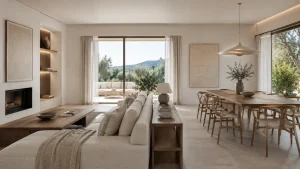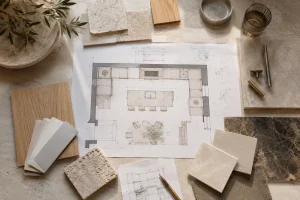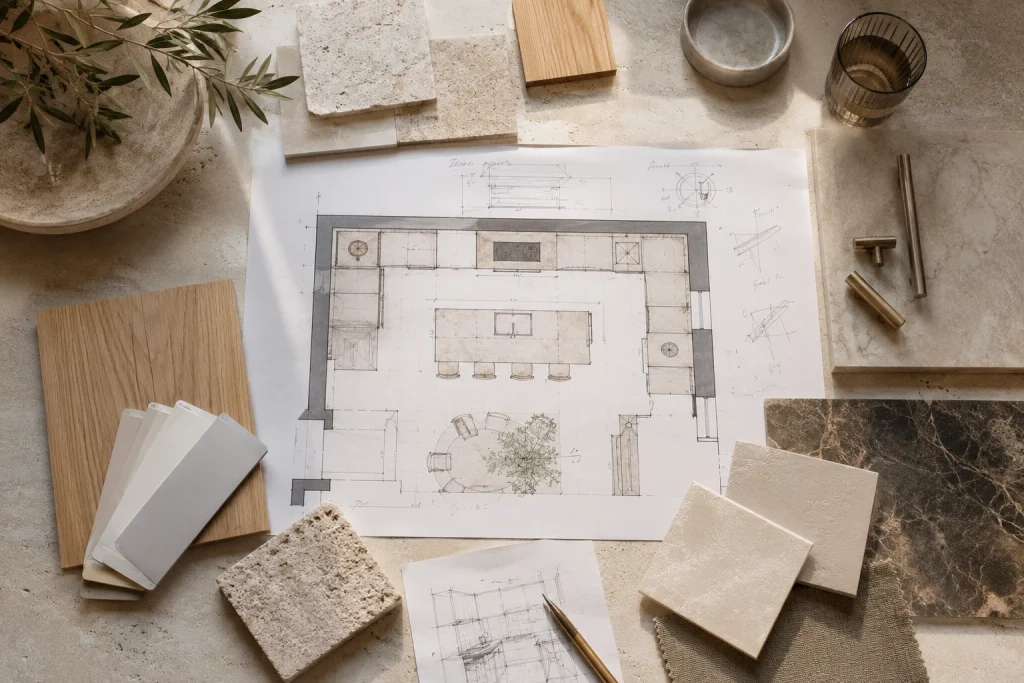
We know that the kitchen is much more than the place where we prepare the food. In many homes it has become the true heart of the house. It is a space for cooking, talking, having breakfast, receiving friends and sharing time with family. Precisely for this reason, its distribution should not be decided solely from a beautiful photograph or a trend that we have seen in a magazine.
In my work as an interior designer in Mallorca, It is common for customers to arrive at the studio with many saved images and a fairly clear idea of the style they want, but with great doubts about how to organize the space. They know that they want a bright, neat and pleasant kitchen, although they do not always know where to place the refrigerator, how much space they need to work or if it really fits that island they imagine.
I also find this situation in owners who have just bought a flat on the plane. The kitchen does not yet exist physically, but they must already make decisions about installations, plugs, lighting, furniture and appliances. At that time it is difficult to anticipate how the space will feel once built.
The distribution of the kitchen allows you to order all those decisions. Determine how we move, where we store food, how far we travel while cooking, and if several people can use the environment without getting upset. In addition, it conditions aspects that are later expensive or complicated to change, such as water intakes, the smoke outlet or the position of some appliances.
In this guide I want to help you understand the basic rules for distributing a kitchen. I must clarify that there is no universal solution that works for all homes. The best proposal will always be the one that responds to the real dimensions of the space, to the architecture of the house and, especially, to the way in which you use the kitchen.
Why kitchen layout should be decided before aesthetics
When we start a reform, it is very easy to get carried away by the most visual decisions. Choosing the color of the furniture, a special countertop or a nice coating is much more exciting than studying tours, openings and distances.
However, a kitchen can be aesthetically flawless and uncomfortable on a day-to-day basis. It can have beautiful finishes, but lack a suitable surface for preparing food. It can also offer a lot of storage and at the same time leave a too narrow passage area.
for that, In my interior design projects, I first define the logic of space and then work on its aesthetic language. The functionality does not limit the design; On the contrary, it provides a solid foundation on which to build it.
Before transferring an idea to the project, it is worth asking:
- Do I have enough space for this solution?
- How will it affect circulation?
- Where will the objects I use daily?
- Will I be able to open furniture and appliances comfortably?
- Does the layout fit my way of cooking?
Decisions that are later difficult to correct
- Water intakes and drains.
- Smoke outlet.
- Electrical outlets.
- Location of appliances.
- Lighting points.
- Furniture distribution.
- Passage areas.
- Relationship with the dining room or living room.
In a flat house, reviewing these aspects before the work progresses can prevent further modifications. In a comprehensive reform, it allows to correctly coordinate the different trades and reduce unforeseen events.
Changing the location of the main areas can have an important influence on the work and the necessary investment. If you want to anticipate these games, I recommend you consult this guide on How much does it cost to renovate an entire kitchen?
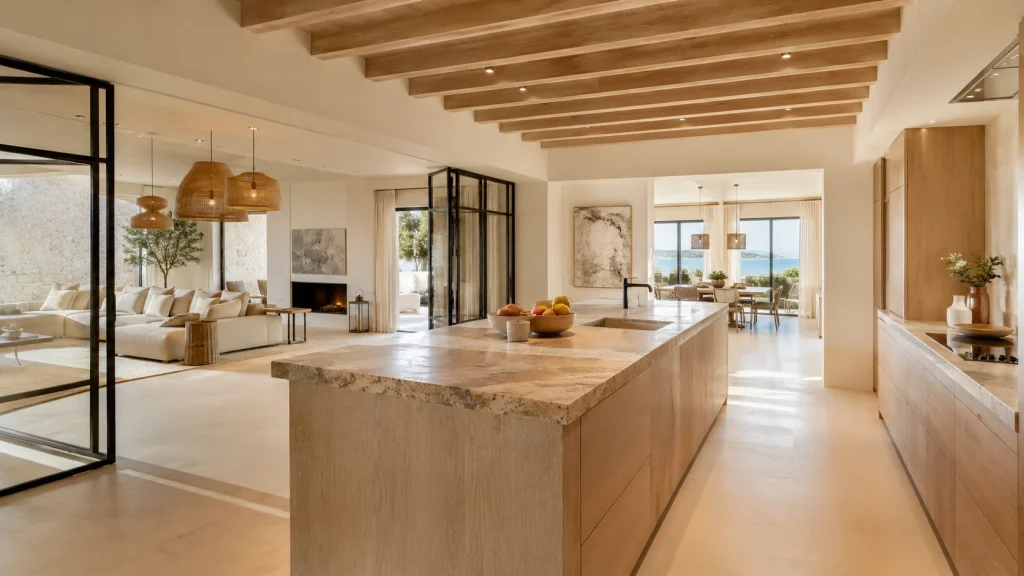
Once the distribution is resolved, we can begin to define the aesthetic language of the kitchen. To explore this second phase of the project, you can consult these Combinations of materials for modern and elegant kitchens .
Start by analyzing the available space
Before deciding where to place each piece of furniture, we must understand the architecture of the room. General measures are important, but they are not enough. You also have to identify all the elements that condition the design.
In many homes in Mallorca, the kitchen also maintains a direct relationship with the dining room, the living room, a patio or a terrace. This connection influences the circulation and the way of orienting the furniture.
Measure the kitchen and work on a real plane
The first step is to get a precise plane. We should not design based only on a visual estimation.
It is convenient to measure:
- Length of each wall.
- Ceiling height.
- Width and height of doors.
- Window dimensions.
- Gaps between holes.
- Position of pillars and setbacks.
- Location of radiators, ducts or registers.
- Current points of water, electricity and gas, if any.
It is also advisable to check if the walls are completely straight. In renovations of old homes, there may be small deviations that affect custom-made furniture.
The plan must allow not only the closed furniture, but also the areas necessary to use them. A refrigerator door, a removable drawer or an open dishwasher take up space and can completely modify the perception of the route.
Locate doors, windows, pillars and installations
Architectural elements are not always a problem. Well integrated, they can become the starting point of an interesting solution.
A window can suggest the location of an illuminated work zone. A pillar can be integrated into a storage composition. A setback can be used to embed columns and prevent them from protruding.
However, interference must be carefully studied. If we place the sink in front of a window, we must check that the tap does not prevent it from opening it. If we place a column next to a door, we must check that it does not block the light input or narrow access.
Existing facilities also condition the budget. It is possible to change them, but first we must assess whether the functional benefit justifies the intervention.
Study the relationship with the rest of the house
The kitchen should not be analyzed as an isolated room. When it is connected to the living room or dining room, it is necessary to study:
- The route from the entrance.
- Circulation to the terrace or outside.
- Proximity to the dining table.
- The views from the social area.
- The way to hide or integrate certain elements.
- The continuity of materials, colors and lighting.
In housing projects in Mallorca, this relationship with the outside is usually of special importance. If the family uses a terrace to eat or receive guests, it is advisable that the journey from the kitchen be direct and not cross uncomfortable work areas.
The distribution should facilitate the complete experience of the house, not only the tasks that occur inside the kitchen.
Define your needs before distributing furniture and appliances
A good kitchen begins with a conversation about habits. Before drawing, I need to understand who will use the space and how.
One of the first questions I ask my clients is How they really cook, not how they imagine they should cook. This nuance is important because The design should be adapted to everyday life, not an idealized version that may never happen.
How you cook and how many people use the space
The kitchen does not need a person who prepares simple dishes than someone who is passionate about gastronomy. It is also not the same to design for a single user than for a couple that cooks simultaneously.
It is convenient to analyze:
- How often it is cooked.
- Number of people using the kitchen.
- Type of usual elaborations.
- Number of utensils and small appliances.
- Need for large surfaces.
- How often guests are received.
- If children participate or circulate through space.
When two people cook at the same time, the distribution should prevent both from needing to occupy exactly the same route. In some cases, organizing the kitchen by zones is more useful than applying the classic work triangle rigidly.
What activities do you want to do in the kitchen?
In addition to cooking, the kitchen can be used for:
- Have breakfast.
- Eat daily.
- Work occasionally.
- Help children with their homework.
- Receive friends.
- Organize the purchase.
- Prepare drinks.
- Connect with an outside area.
- Share time while someone else cooks.
Each activity requires space and equipment. A bar can be practical for a quick breakfast, but it doesn’t always replace a comfortable table. An island can become a social point, although it must be designed without interfering in the preparation area.
The key is to set priorities. Trying to incorporate all the functions in a limited space can end up harming the most important ones.
How much storage do you really need?
Before projecting cabinets, I recommend checking what should be stored in the kitchen.
We can classify objects into four groups:
- Daily use items.
- Frequently used items.
- Occasional utensils.
- Parts that could be stored somewhere else.
This classification helps decide what you need to stay close to the work zone and what can be placed in less accessible modules.
A kitchen with many closets is not always well resolved. If everyday objects are too high, too low, or far from the area where they are needed, the space will still be uncomfortable.
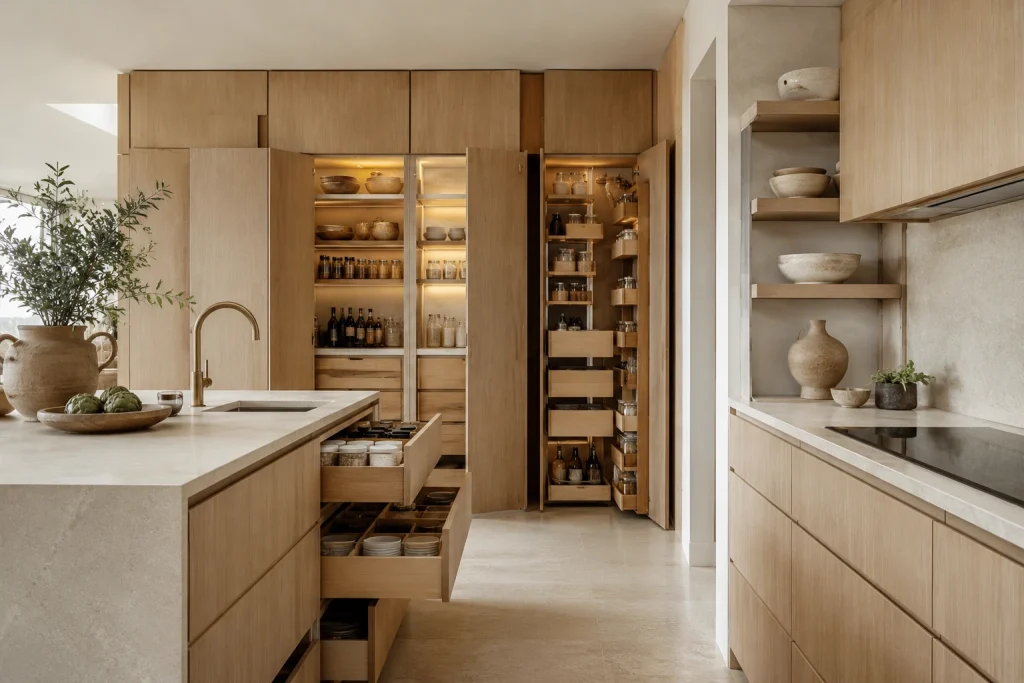
The working triangle in the kitchen
The working triangle is one of the best known concepts in kitchen distribution. Match three main points:
- Refrigerator.
- Sink.
- Cooktop.
The idea is to prevent these elements from being too far away or that the paths between them are uncomfortable.
what problem are you trying to solve
As we cook, we usually repeat a sequence:
- We take food from the fridge or pantry.
- We wash or prepare them.
- We cook them.
If these points are well connected, we reduce the movements and avoid constantly crossing the room.
The triangle also helps detect obstacles. A table, a poorly positioned island or a passing area can interrupt the routes.
It also serves as an initial tool to check that none of the points is isolated.
Types of kitchen layout: a first orientation
The floor plan of the room, its dimensions and its connections condition the possible configurations. However, there is no rule that can always be applied: the same way can be resolved in different ways.
This content works as a general guide. Each typology deserves a specific analysis of measures, advantages and limitations.
| Distribution | When can it fit? | Main advantage | What should you check? |
|---|---|---|---|
| Linear | Narrow, open or compact spaces | Concentrates all on a single front | that there is enough continuous surface |
| In parallel | Elongated plants with sufficient width | Take advantage of two opposing walls | The distance between the fronts |
| In l | Open, square or rectangular rooms | Release a central area | The use of the corner |
| In u | spaces with sufficient width | Offers a lot of countertop and storage | that the central area is not narrow |
| With island | Large or open kitchens | Add surface and social function | circulation around |
| With peninsula | spaces that need to delimit environments | Make better use of the space than some islands | that does not close the access |
| Open | Homes with kitchen connected to the day area | Promotes light and social life | Noises, smells and visual coherence |
| With office | kitchens with space to eat | facilitates everyday use | The relationship between table and work area |
The choice should not be based solely on the shape of the plant. The habits, the amount of storage and the relationship with the rest of the house also intervene.
Measurements and distances that you must check in the plane
The specific dimensions depend on the project, the furniture and the people who will use the kitchen. However, there are general references that help detect problems.
These measures should not be interpreted as absolute rules. A difference of a few centimeters can be important depending on the opening of an appliance or the presence of a main step.
Passage zones
Between two fronts facing, it is usually necessary to leave a space that allows opening drawers and moving.
In many cases, around 90 centimeters It can function as a practical minimum reference, but if several people will use the kitchen or there are facing appliances, it may be convenient to have more space.
Around an island we must also consider:
- Opening of drawers.
- Busy stools.
- Appliance doors.
- Tours to other rooms.
Distances between work fronts
Too big a gap forces you to walk more. A small separation generates interference.
The objective is to balance proximity and freedom of movement.
Space to open appliances
We must especially review:
- Large door refrigerators.
- Dishwasher.
- Ovens.
- Freezers.
- Wine Bars.
- Appliances integrated in columns.
You also have to check if, when opening, they block an access or prevent the use of another piece of furniture.
Furniture height and depth
Standard measurements can work for many users, but they are not always the most suitable.
The height of the countertop should, as far as possible, be adapted to those who cook regularly. too low a surface forces to lean; A too high can be uncomfortable for kneading or working.
In custom projects, these details make a significant difference.
Common mistakes when distributing a kitchen
Understanding frequent errors Allows you to review a proposal before executing the work.
Choose a distribution because it works in a photograph
A kitchen must adapt to the real space. Copying an image without studying measurements, circulation and installations usually leads to impractical solutions.
wanting to include an island without enough space
The island is one of the most desired elements, but it is not always the best option.
An island too big can block routes. A too small may not justify the loss of space. In some projects, a peninsula or a table offer better results.
Prioritize storage and block circulation
Adding furniture may seem like a good way to take advantage of every inch. However, if we narrow the step too much, the kitchen will become uncomfortable.
Useful storage is one that we can easily access.
Misplace the appliances
Some common errors are:
- Dishwasher away from the sink.
- Oven without supporting surface.
- Refrigerator blocking a tour.
- Plate too close to a wall.
- Facing appliances that cannot be opened at the same time.
Leave little preparation surface
The countertop is usually quickly filled with small appliances and everyday objects. Therefore, we must reserve a really free area to work.
Do not review the facilities
Moving water, electricity or extraction may be possible, but it should be planned before starting the work. Solving it late increases costs and limits the design.
Design for the plane and not for daily life
A distribution can be ordered in two dimensions and fail during use.
Before approving it, you have to simulate concrete actions:
- Arrive with shopping bags.
- Save food.
- Prepare a meal.
- Open the dishwasher.
- Serve the table.
- Cook with another person.
- Access the outside.
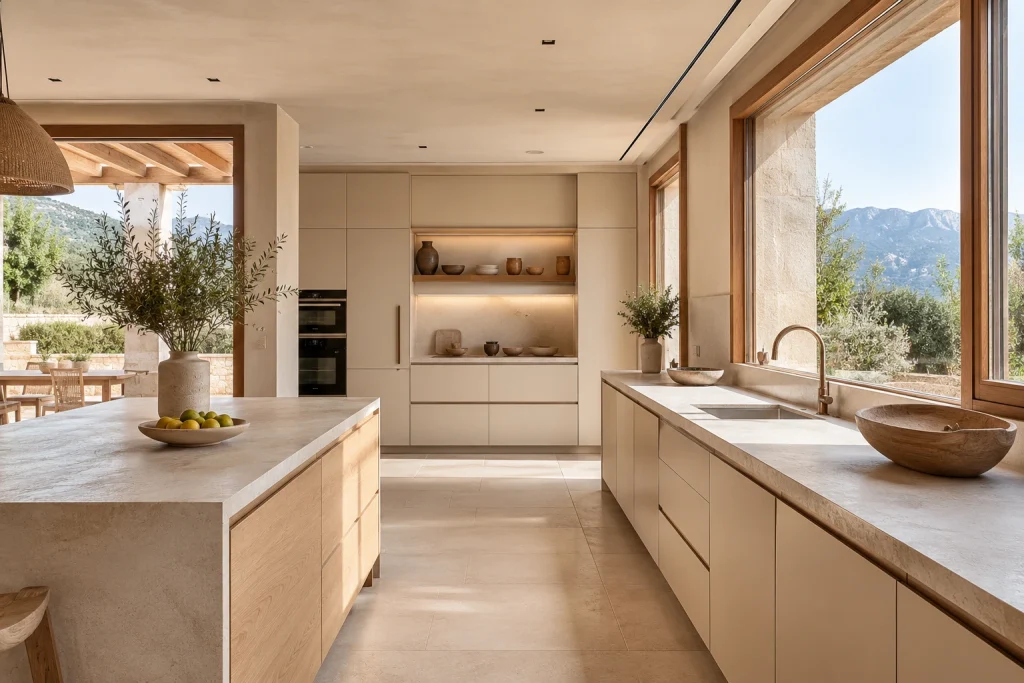
Do you already have a kitchen layout proposal but are unsure whether it will work in everyday life?
Before finalising the layout or carrying out the installations, it is important to review the circulation, door and drawer clearances, work zones and storage capacity. At Virginia Pérez Interiorismo, we can assess your proposal and help you identify decisions that could become difficult or costly to change later.
How to validate the distribution before you start the reform
Once a proposal has been developed, it is time to check it out.
Represents open furniture and appliances
The openings and the space they occupy should appear on the plane. This allows you to detect interference that is not seen when all the elements are closed.
Simulate frequent tours
Imagine step by step:
- How do you get with the purchase?
- Where do you support the bags?
- How do you store food?
- Where you wash and prepare.
- How do you go from one task to another?
- How do you serve food?
- How you collect and clean.
If any of these routes are complicated, it is advisable to review the proposal.
Observe the kitchen from different points
In an open kitchen, we must assess how it looks from:
- The room.
- The dining room.
- The entrance.
- The terrace.
- The circulation areas.
This helps decide where to group the columns, which elements to integrate, and which areas should keep more clear.
Review hard-to-modify decisions
Before starting the work, confirm:
- Facilities.
- Position of the appliances.
- Lighting.
- Furniture dimensions.
- Openings.
- Countertop height.
- Materials.
- Encounters with walls and pavements.
Contrast your ideas with a professional
An interior designer does not only intervene to choose finishes. His job is to connect architecture, functionality, aesthetics and installations within a single proposal.
The professional look allows us to anticipate problems that can go unnoticed when we analyze each decision separately.
Would you like a kitchen that is as practical as it is beautiful?
Planning the layout is the most important step in ensuring that the heart of your home reflects the way you cook, entertain and spend time together. If you understand your needs but are unsure how to translate them into a floor plan, at Virginia Pérez Interiorismo we design bespoke kitchens in Mallorca, optimising every centimetre and coordinating the entire project from start to finish.
Kitchen Layout FAQs
What is the best distribution for a kitchen?
There is no universally better distribution. The choice depends on the plant, the dimensions, the facilities, the number of users and the way in which the space is used. The best distribution is the one that facilitates the routes, offers enough storage and adapts to your habits.
What should be decided first in a kitchen renovation?
It is convenient to start with the needs and the general distribution. Then the work zones, the position of the appliances and the installations are defined. Materials, colors and finishes should be chosen when the functional base is already resolved.
What is the working triangle?
It is a way of organizing the relationship between refrigerator, sink and hob. It seeks to reduce displacements and facilitate the usual sequence of work. It is useful as a reference, although it should not be applied rigidly in all kitchens.
How to know if a kitchen will be comfortable?
It is necessary to check the routes, the passage areas, the supporting surfaces and the openings of furniture and appliances. It is also convenient to simulate everyday actions and consider what happens when several people use the space at the same time.
How much space does it take to place an island?
It depends on the size of the island, the furniture that surrounds it and the function it will have. It is essential to leave sufficient areas of passage and consider drawers, appliances and stools. Before incorporating it, it is convenient to study if a peninsula or a table could offer a more suitable solution.
When should I consult an interior designer?
The best time is before closing the distribution and running installations. Consulting the project in an early phase allows you to assess alternatives, avoid costly errors and coordinate functionality, architecture and aesthetics.
Can you change the layout of a kitchen on a plane?
In many cases yes, especially if the work is still in an initial phase. However, the possibilities will depend on the promoter, the facilities and the deadlines. The sooner the proposal is reviewed, the more margin there is usually to make modifications.